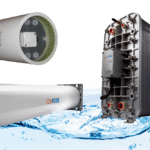

Horizontal Vacuum Belt Filter (HVBF) for Continuous Slurry Dewatering
The UCC Horizontal Vacuum Belt Filter (HVBF) is designed for high-efficiency continuous slurry dewatering in demanding industrial environments. Unlike batch filtration systems, horizontal vacuum belt filters provide uninterrupted solids separation, consistent cake formation, and superior washing performance.
How It Works
Our Mobile Solids Dewatering Unit combines proven engineering and advanced materials to quickly separate solids from liquids in industrial slurry streams. Designed for rapid deployment and consistent performance, it handles a wide range of sludges and abrasive materials.
Key Features
• High-capacity belt filter for rapid dewatering
• Mobile design for easy relocation on-site
• Robust construction to handle abrasive and corrosive slurries
• Adjustable belt speed and vacuum pressure for optimized solids removal
• Pilot-Friendly: Test on-site before full-scale deployment to validate performance and optimize configuration
Technical Highlights
• Typical throughput: 5–20 tons/hour (application dependent)
• Moisture reduction: 30–60% depending on material
• Belt widths: configurable for application needs
• Fully mobile: can be deployed in hours without permanent installation
Industries Served
Our unit provides versatile, reliable dewatering for a variety of heavy industries:
Mining & Minerals
• Dewaters tailings, concentrates, and mineral slurries
• Reduces disposal volume and operating costs
Power Generation
• Treats ash slurry and other process residuals
• Improves handling and compliance with environmental regulations
Steel & Metals
• Manages sludge from water treatment, cooling, and process operations
• Minimizes downtime and maintenance needs
Pulp & Paper
• Dewaters fiber slurries and process wastewater
• Extends equipment life and lowers overall cost of ownership
Chemical & Petrochemical
• Handles industrial process sludges and byproducts
• Protects downstream equipment and reduces waste transport
Municipal Wastewater / Water Reuse
• Supports solids removal in municipal treatment applications
• Flexible for seasonal or temporary projects
Benefits & Outcomes
• Rapid Deployment: Get your unit up and running within hours
• Operational Efficiency: Reduce downtime, maintenance, and disposal costs
• Consistent Performance: Proven solids removal across multiple slurry types
• Pilot Testing Available: Validate performance on-site before committing to full-scale operations
• Flexible Service: Supports both short-term projects and long-term operations
• Cost Savings: Lower total cost of ownership vs. fixed dewatering systems
Frequently Asked Questions About Horizontal Vacuum Belt Filters
When is a horizontal vacuum belt filter the preferred dewatering technology?
HVBF systems are widely applied in FGD gypsum dewatering, mining and minerals processing, and chemical slurries due to their ability to maintain stable filtration performance under variable solids loading.
What process variables most influence HVBF performance?
- Slurry solids concentration and particle size distribution
- Cake permeability and compressibility characteristics
- Vacuum level and filtration zone configuration
- Belt speed and residence time
- Wash water distribution and efficiency
- Slurry chemistry and temperature
Proper evaluation of these variables is critical to achieving target moisture content and throughput. System design must account for both steady-state and upset operating conditions.
How do horizontal vacuum belt filters compare to filter presses?
Horizontal vacuum belt filters provide continuous processing, making them suitable for high-volume applications with consistent slurry feed. Filter presses operate in batch cycles, which may limit throughput but can achieve lower final moisture in certain materials.
HVBF systems are often preferred where production stability, washing capability, and process integration are more important than achieving the absolute lowest cake moisture.
What types of materials are well suited for HVBF systems?
- FGD gypsum and scrubber byproducts
- Mineral concentrates and tailings
- Chemical precipitates
- Industrial process solids
- Certain wastewater residuals
Materials that blind filter media or exhibit extremely low permeability may require alternative filtration approaches or pretreatment strategies.
How is moisture reduction controlled in an HVBF system?
Effective system design ensures moisture targets are met while balancing throughput requirements and wash efficiency.
What operational advantages does continuous vacuum filtration provide?
- Maintain stable production rates
- Reduce process variability
- Improve solids handling predictability
- Minimize operator intervention
- Support consistent downstream performance
For many industrial processes, these factors drive lifecycle cost reductions more significantly than peak dewatering metrics alone.
What design considerations are critical for reliable HVBF operation?
- Reliable horizontal vacuum belt filter performance depends on:
- Uniform slurry distribution across the belt
- Proper vacuum system sizing and sealing
- Filter media selection for material characteristics
- Drainage zone configuration
- Wear protection and component durability
- Maintenance accessibility
Applications with abrasive solids, scaling tendencies, or variable feed conditions require careful engineering evaluation to preserve long-term performance.
How does cake washing function in a horizontal vacuum belt filter?
Wash efficiency depends on cake permeability, wash zone design, and fluid distribution control.
Ready to Improve your Solids Dewatering Process?
Our team of experts are happy to help answer any questions you have about UCC’s mobile solutions.