Ultrapure Water (UPW) Systems — Engineered for Precision Industries
UCC Environmental designs, delivers, and services full-lifecycle Ultrapure Water (UPW) systems for semiconductor fabs, pharmaceutical manufacturing, microelectronics, power and other critical industries where water purity directly impacts production, reliability and regulatory compliance. Our state-of-the-art, engineered solutions combine multi-stage purification, point-of-use polishing, validated distribution and continuous monitoring to meet the strictest resistivity, TOC and particle specifications.
Why Ultrapure Water matters
When water touches a critical process, every trace contaminant matters. Ions, organics, particles, and microbes can cause wafer defects, failed batches, and repeated validation work. A true UPW system must do more than create pure water—it must maintain purity across the entire distribution loop and at every point of use. That means high-efficiency purification, engineered piping and materials, and trace contaminants monitoring produce continuous reliable production.
Three Essential Stages of an Ultrapure Water System
Makeup Systems
• Granular Activated Carbon and Chlorine Control
• Softening and Scale Control
• pH Adjustment
• Reverse Osmosis (RO) for thorough contaminant removal
• Ultrafiltration
Primary Systems
• TOC Reduction UV
• Membrane-Based Degasification
• Deionization (CDI, EDI or mixed beds)
• Sub-Micron Filtration
These systems effectively remove critical impurities such as silica and boron, which are vital for semiconductor manufacturing.
Polishing Systems
• TOC Reduction UV
• Membrane-Based Degasification
• Non-Regenerable, Low TOC, Mixed Bed Deionization
• Submicron Filtration and Ultrafiltration
Advanced ion exchange resins and filtration technologies guarantee that the most rigorous ultrapure water specifications are met, ensuring flawless production processes.
UCC Ultrapure Water Solutions Services and Solutions
Full engineering, delivery and lifecycle support — from pilot units to permanent plants and retrofit modernization. Our capability set includes: design & engineering, equipment procurement, installation & commissioning, validation support, operator training, preventive maintenance, and emergency response/service contracts.
Core technology & process elements
- Pretreatment: media filtration, softening, dechlorination, antiscalant dosing and ultrafiltration.
- Primary purification: multi-stage RO, membrane degasification, UV disinfection or TOC reduction.
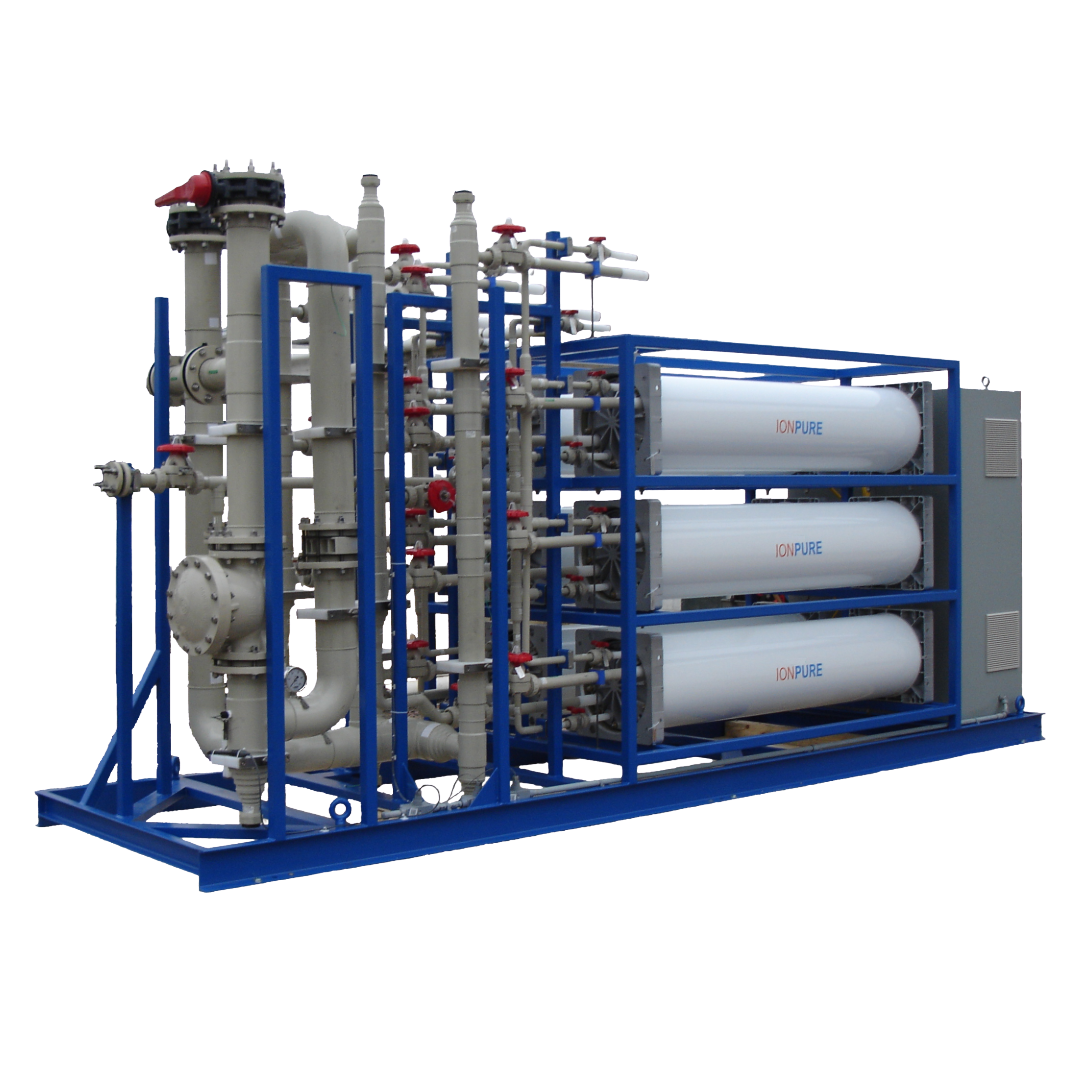
- Final polishing is achieved through Electrodeionization (EDI) or mixed-bed ion exchange, allowing the system to reach ultra-high resistivity levels up to 18.28 MΩ·cm.
- Point-of-use polishing and sterilizing filtration (0.2 µm) for critical hooks.
- Distribution: The distribution loop is engineered with high-purity polymer piping and hygienic components to preserve water quality as it circulates, minimizing the risk of recontamination throughout the system.
Monitoring & Analytics
- We integrate real-time TOC and resistivity measurement into the control system to maintain water quality throughout operation. Advanced online analyzers, including TOC and boron, can be added to identify resin breakthrough early and keep EDI and mixed-bed polishers operating at peak efficiency.
- Offsite monitoring
Key differentiators
- Best Available Technology (BAT): we select best-fit components rather than forcing a single vendor stack so you get performance and long-term serviceability.
- Lifecycle optimization: vendor upgrades, pilot-to-plant scale studies and data-driven performance tuning to reduce operating cost and chemical use.
- Regulatory & validation support: documentation and execution support for customer quality programs.
- Rapid pilot & retrofit capability: mobile pilots and modular skids to prove performance onsite before committing capex.
- Mobile Equipment: rapid-deployment ultrapure water mobile systems provide temporary or supplemental UPW capacity onsite during maintenance, emergencies, or plant expansion — ensuring continuous production without purity loss.
- UL 508A Certified Control Panel Fabricator
How We Work
- Assess — feed water and product water requirements, and process selection.
- Engineer & implement — detailed design, procurement, commissioning and validation documentation.
- Operate & optimize — monitoring, preventative maintenance, spare-parts program and performance tuning.
Frequently Asked Questions
What does an Ultrapure Water (UPW) system remove?
What purity levels can a UPW system achieve?
What are the main stages of a UPW system?
A complete UPW system includes makeup treatment, primary purification, final polishing, and point-of-use filtration supported by a high-purity distribution loop.
Why is TOC and resistivity monitoring important?
What technologies are used for final polishing?
How do you prevent recontamination in a UPW system?
What industries rely on UPW?
Do you offer pilot testing for UPW systems?
What affects the operating cost of a UPW system?
How often should a UPW system be serviced?
Ready to optimize your water systems?
Reach out to discover more about our ultrapure water solutions for the microelectronics industry or schedule a consultation with our experts today.